
No-Line Bifocal Lenses in Pakistan: Distance & Near Vision Without the Visible Line
For decades, people who required both distance and reading correction had a familiar choice: traditional bifocal glasses with a visible line or more advanced progressive lenses.
But there is another option that many spectacle wearers in Pakistan may not know exists: no-line bifocal lenses.
These lenses are designed for people who need distance and near vision in the same pair of glasses but would prefer not to have the obvious segment line associated with conventional bifocals.
The important point is that the no-line bifocal lenses discussed here are not ordinary progressive lenses and are not traditional blended bifocals.
They use a modern, progressive-style lens design to provide two primary areas of vision:
Distance vision + near vision
There is no dedicated intermediate viewing zone.
This creates an interesting middle ground for suitable wearers: the functionality of a bifocal, with a significantly more modern and discreet cosmetic appearance.
At Al-Aziz Optical, no-line bifocal lenses provide another option for customers looking for bifocal lenses in Pakistan without the traditional visible reading segment.
What Are No-Line Bifocal Lenses?
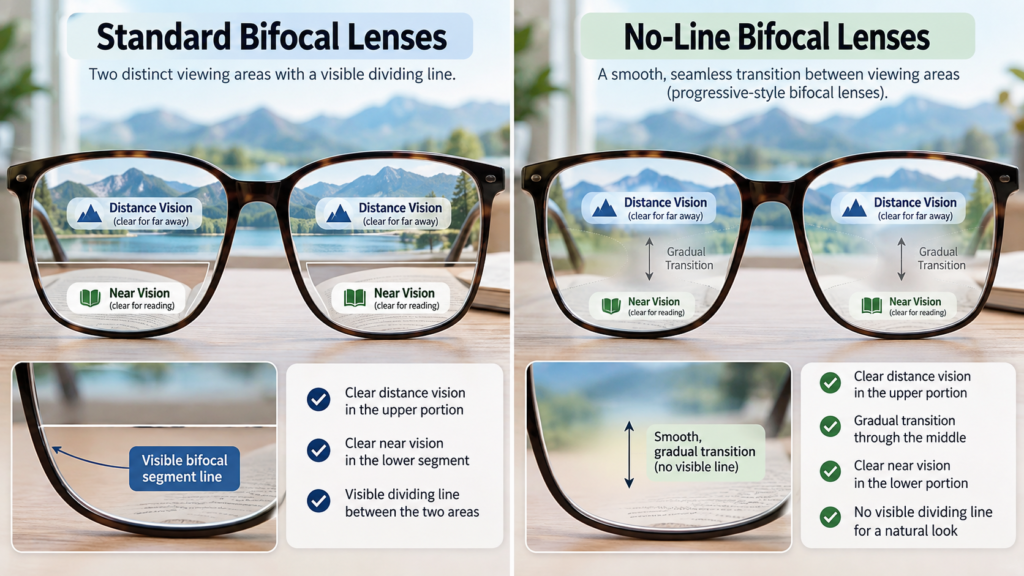
A conventional bifocal contains two optical powers in the same spectacle lens.
The upper area is generally used for distance vision, while the lower area provides the additional power required for reading and close work. This is also how the American Academy of Ophthalmology describes the fundamental function of bifocal lenses: correction for far and close vision within the same lens.
Traditional bifocals make the boundary between these two powers very obvious.
You can physically see a line, usually across a small D-shaped, round or other shaped reading segment near the bottom of the lens.
No-line bifocal lenses remove that obvious segment appearance.
Instead, the lens surface has a smooth, modern appearance similar to a progressive or single-vision lens.
However, unlike a normal progressive lens, the design is focused specifically around:
Clear distance vision
Clear near vision
No dedicated intermediate zone
Some modern optical lens designers describe this type of lens as an invisible bifocal, specifically optimized for two viewing distances with no intermediate area.
The result is essentially a modern interpretation of the traditional bifocal concept.
No-Line Bifocals Are Not Progressive Lenses
This distinction is particularly important.
The term “no-line bifocal” is often used online to describe progressive lenses, but technically the two do not necessarily mean the same thing.
A conventional progressive addition lens provides three major viewing ranges:
Distance → Intermediate → Near
The power changes gradually as the wearer looks farther down the lens.
The intermediate corridor is particularly useful for arm’s-length activities such as computer screens, dashboards and some office work.
The no-line bifocal lenses discussed in this article are different.
Their purpose is:
Distance → Near
There is no dedicated intermediate section.
Think of them as having the visual objectives of a bifocal but the cosmetic appearance and surface sophistication associated with modern freeform or progressive-style lens design.
Why Choose No-Line Bifocal Lenses?
The biggest attraction is simple:
You get bifocal functionality without looking like you are wearing conventional bifocals.
For many people, particularly customers who start needing a reading addition in their 40s and 50s, the visible line of an ordinary bifocal can be undesirable.
No-line bifocals provide a more discreet alternative.
The Cosmetic Advantage Matters More Than You Might Think
Spectacles sit directly on your face.
Unlike many medical devices, glasses also form part of your appearance every day.
Traditional bifocals can sometimes create an association with older-style eyewear because the visible reading segment has existed for generations.
Removing that line changes the appearance considerably.
A modern no-line bifocal allows:
Cleaner-looking lenses
Better presentation of premium frames
A more contemporary appearance
Less obvious indication that the wearer requires reading correction
Greater confidence for some first-time multifocal wearers
There is no reason that needing reading correction automatically has to mean wearing glasses that look traditionally “bifocal.”